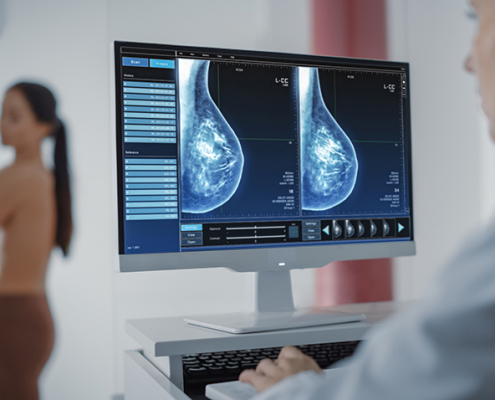
Diagnostic Mammography
A mammogram is a special low dose x-ray examination of the breasts. Doctors use diagnostic mammography to investigate breast symptoms, such as a lump, nipple discharge, change in breast shape, or implant rupture. You may also request it if you have a strong family history of breast cancer.
Diagnostic Mammography is a useful tool for finding breast cancer early. It can detect small changes in the breast before you or your doctor can feel them. 3D mammography (tomosynthesis) can further improve the accuracy of the mammogram, even for women with dense breasts.
Breast density increase can mask breast cancer visibility on a mammogram and can also associate with increased risk. Geelong Breast Clinic uses VOLPARA breast density software to accurately determine breast density. Your mammogram report includes your breast density measurement for your doctor.
Diagnostic Mammography uses very low dose radiation to obtain images. We strictly monitor and regulate the radiation dose at Geelong Breast Clinic to ensure that exposure always remains within medical safety guidelines.
GEELONG BREAST CLINIC SERVICES
WHAT IS MAMMOGRAPHY
A mammogram is a special low dose x-ray examination of the breasts. Diagnostic Mammography is used to investigate breast symptoms, for example a lump, nipple discharge, change in breast shape or implant rupture. It may also be requested if you have a strong family history of breast cancer.
Diagnostic Mammography has been shown to be a sensitive tool in the early detection of breast cancer because it can find small changes in the breast, even before they can be felt by you or your doctor. 3D mammography (tomosynthesis) can further improve the accuracy of the mammogram, even for women with dense breasts.
Increased breast density can mask the visibility of breast cancer on a mammogram, and can also be associated with increased risk. Lake Imaging in Geelong uses VOLPARA breast density software to accurately determine breast density. You breast density measurement is included in your mammogram report to your doctor.
HOW DO I PREPARE FOR DIAGNOSTIC MAMMOGRAPHY AND BREAST TOMOSYNTHESIS (3D MAMMOGRAM)
There is no special preparation for Diagnostic Mammography. You can eat and drink normally on the day.
If you are pregnant, breast feeding or have breast implants, please notify our staff at the time of making your appointment.
You may be more comfortable if you wear a two-piece outfit, because we will ask you to remove your clothing from the waist up and wear a gown. You may also need to remove jewellery from the chest and neck region.
ON THE DAY OF YOUR MAMMOGRAM
Your examination will be performed by a female radiographer who has specialised in Diagnostic Mammography. She will explain the procedure to you, and may ask you some questions about your symptoms and past history.
During your mammogram, each breast is briefly compressed, so that all the breast tissue may be clearly visualised by the radiologist. This only takes a few seconds and, whilst some patients find this uncomfortable, it should not be painful. Our radiographers are specially trained to ensure that it is as comfortable as possible.
During the 3D component, you may notice the X-ray arm sweep in an arc, taking multiple low-dose images in a few seconds.
Most mammogram examinations take 15 minutes to complete. You may be asked to wait briefly whilst your images are checked.
AFTER YOUR MAMMOGRAM
When your mammogram is complete, the images will be examined by the radiologist. Sometimes further mammographic images are required or an ultrasound is then performed. This is not uncommon.
RESULTS
Sometimes we are able to give you your results on the same day. Sometimes further tests are needed. We will send a report to your referring doctor. You should return to your doctor to discuss these results. Allow at least 2 days after your mammogram for your follow-up visit with your doctor.
BREAST SELF-EXAMINATION
Whilst mammograms do detect most breast cancers, they do not find all of them. It is important that you continue to examine your breasts each month, and have a regular check with your doctor. If you are uncertain how to examine your breasts, you can ask your doctor to teach you.
PATIENT SAFETY
Diagnostic Mammography uses very low dose radiation to obtain images. Radiation dose at Lake Imaging is strictly monitored and regulated so that exposure is always within medical safety guidelines.
3D Mammography
(Tomosynthesis)
WHAT IS 3D Mammography (Tomosynthesis)
3D Mammography (Tomosynthesis) is new breast imaging technology that has been proven to improve the accuracy in diagnosis of breast cancer. It is performed as part of a diagnostic mammogram examination. In addition to the standard mammographic views, a specialised view (tomographic) is taken to produce 3-D images. Tomographic view is completed within seconds from a single sweep of the x-ray arm, creating a series of detailed images which together make up the 3D imaging of the breast.
For the tomographic view, the x-ray arm will move in an arc above the breast for a short time. Some women may experience discomfort with compression; however, if you experience pain during the mammogram you should inform the radiographer. You can also ask for the procedure to stop at any time.
BEFORE 3D Mammography
We recommend that you advise the radiographer if you have sensitive breasts, they will work with you to make sure that the mammogram is as comfortable as possible. Unfortunately, compression of the breast is essential to ensure an accurate image and minimise the amount of radiation used.
AFTER 3D Mammography
After the routine views of your breast have been obtained the radiographer will ask you to wait while they are examined by a radiologist to ensure that all the images needed have been obtained.
A breast ultrasound is often requested as a complementary test at the time of the mammogram or at a later date as a means of gathering more information for a complete examination.
Breast Vacuum-Assisted Core Biopsy (Stereo or Tomo)
WHAT IS A VAB?
A breast biopsy is a test that takes cells or tissue from the breast to be examined by a pathologist under the microscope. The biopsy gives you and your doctor important information about your breast tissue which helps make a diagnosis or plan treatment.
HOW DO I PREPAREE FOR A VAB
There is no special preparation for VAB. You may eat and drink normally on the day.
You will require a doctor’s referral and an appointment.
Please notify our booking staff if you are taking medications that thin your blood, as these may need to be temporarily stopped before the biopsy. We will discuss this with your doctor. Please do not stop taking these medications until you are advised by us to do so.
You may be comfortable wearing a 2-piece outfit because you will be asked to remove clothing from the waist up and wear a gown.
DURING A BREAST VACUUM-ASSISTED STEREOTACTIC CORE BIOPSY
When you arrive at Lake Imaging you will be asked to remove all jewellery and clothing from the waist up, and change into a loose-fitting examination gown.
VAB is performed while sitting or lying in a special chair with the breast compressed in the same way as for a mammogram. Several keyhole images will be taken to accurately identify the area for the biopsy.
The skin of the breast is then washed with antiseptic before a very fine needle is used to give local anaesthetic to numb the breast in the area for biopsy. The local anaesthetic may sting for a few seconds when it is being given, and then the area will become numb. A small incision will be made and several samples taken. The biopsy procedure may sometimes feel uncomfortable but is usually not painful because of the local anaesthetic that has been given. The process of taking the biopsy lasts just a few minutes.
After the samples have been taken, the biopsy area will be held firmly for a few minutes to minimize any bruising or bleeding, and then covered with a dressing that will be checked before you leave.
Please allow about an hour for the procedure.
AFTER A BREAST VACUUM-ASSISTED STEREOTACTIC CORE BIOPSY
After the procedure, the biopsy site may be tender or show some bruising. You may place an ice pack over the biopsy site for no more than 20 minutes. We suggest taking Paracetamol for discomfort. You will be able to leave the clinic shortly after the procedure.
• You may drive yourself home after the procedure.
• Most people can return to work the same day.
• You should refrain from exercise for 24 hours following your biopsy.
• Your dressing may be worn in the shower and removed after two to three days.If your breast becomes red, swollen or tender in the days after your biopsy please consult your doctor or contact the Lake Imaging clinic to review the biopsy site.
Results from VAB are usually available within 48 hours, but may take up to a week. Our nurses will ensure that you have an appointment either in our results clinic or with your referring doctor to get your results as soon as possible.
PATIENT SAFETY
VAB is a safe procedure, and most people do not find it uncomfortable. Please advise the radiologist if you are experiencing any pain.
After the local anaesthetic wears off, you may experience some discomfort in the breast, but this is usually eased by taking paracetamol.
Fainting during the biopsy is uncommon because you will be sitting or lying during the procedure, but please let the doctor know if you are prone to fainting.
Most people develop some bruising of the skin at the biopsy site lasting for a few days after the procedure. Sometimes a bruise may develop within the breast tissue which may cause a tender lump. This may take one to two weeks to disappear.
Infection can sometimes occur when tissue is cut, but this is rare following VAB. If your breast becomes red, swollen or tender in the days after your biopsy, please consult your referring doctor or contact Lake Imaging to review your biopsy site.